


Putumayo-Içá Biocultural Corridor
A Free-Flowing River at the Heart of Four Nations
The Putumayo–Içá River originates in the Colombian Andes and winds its way through Colombia, Ecuador, Peru, and Brazil. Along the way, it forms natural borders, between Peru and Colombia, and across much of the Ecuador–Colombia frontier. Remarkably, the Putumayo is one of the few Amazonian basins free from dams, ensuring that the river’s flow and the life it sustains remains uninterrupted.
One of the Most Diverse Places on Earth
The basin is a global treasure trove of biodiversity. It ranks among the world’s richest regions for birds, bats, frogs, freshwater fish, trees, and butterflies. It is also home to around 19 distinct Indigenous groups, whose cultural and ecological knowledge is deeply interwoven with the forests and rivers. Today, nearly 46.5% of the corridor is recognized Indigenous territory, 23.5% is protected as conservation land, and another 6% is under proposal—a landscape where cultural and biological diversity thrive together.
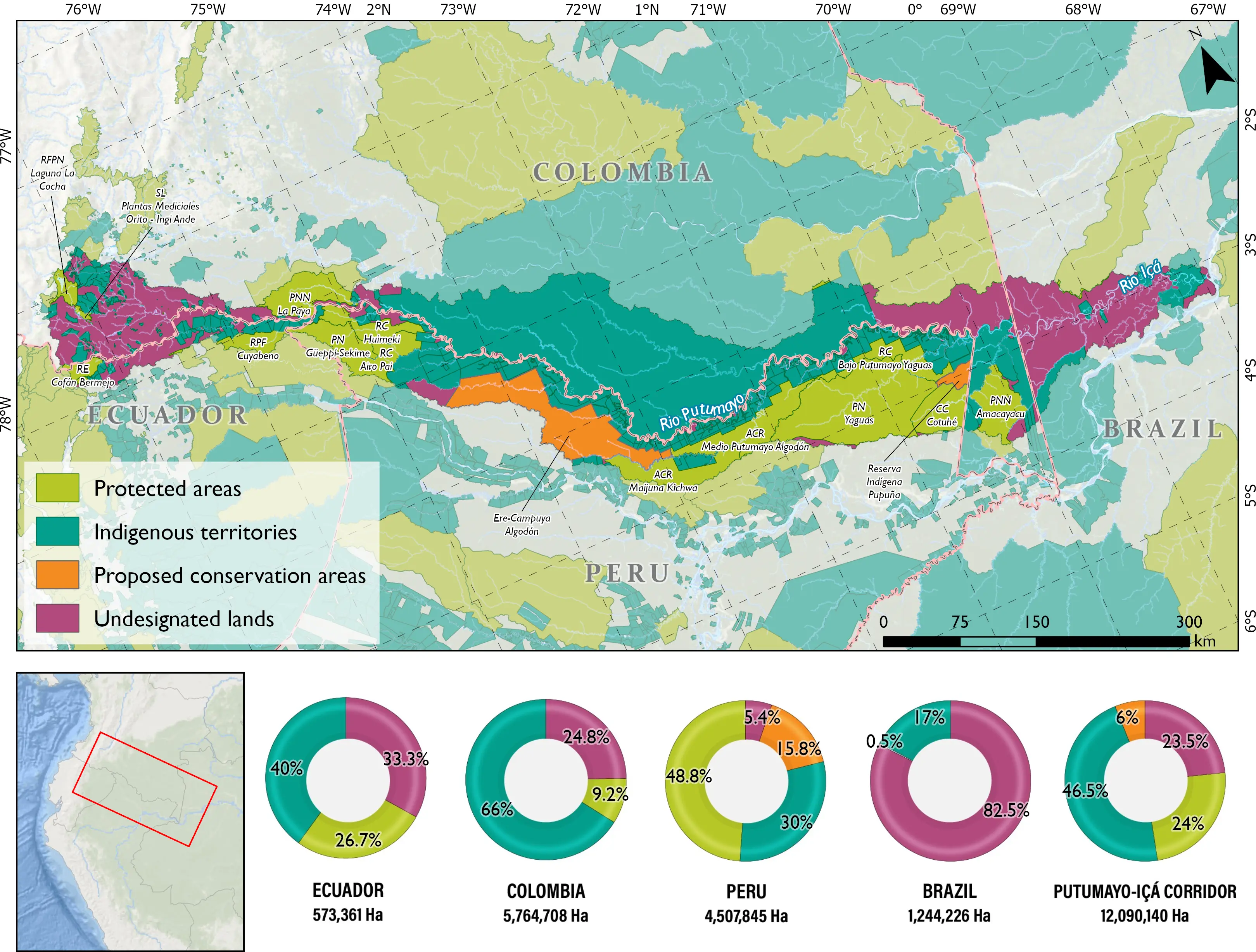 Proportion of Indigenous territories, Proposed and Current Protected Areas, and Other Territories within the Putumayo-Içá Biocultural Corridor
Urgency and Challenges
Despite its promise, the corridor faces growing threats: illegal deforestation, gold mining, overharvesting of fish, and large-scale development projects that are poorly suited to this fragile environment. The Andes–Amazon Program and its partners have been committed to addressing these pressures by supporting Indigenous leadership, generating scientific and cultural knowledge, and securing decision-making power for local communities.
The Keller Science Action Center has been committed to ensuring the region's long-term persistence by supporting information sharing to collectively find opportunities and threats. The intent was to align various actors living in and impacting the watersheds and bring the basin's neighboring countries together for culturally relevant and nature-based conservation actions.
Knowledge and Encounters
Since 2001, the Field Museum has conducted nine Rapid Inventories within the Putumayo–Içá basin (most recently RI33) and two additional inventories near the basin. These expeditions, designed to quickly document biodiversity and cultural values, have directly contributed to creating six protected landscapes: two national parks, three regional conservation areas, and three Indigenous reserves. Building on this foundation, the Andes–Amazon Program convened a series of Encounters between 2017 and 2022, in Iquitos, Leticia, Tarapacá, and Santo Antônio do Içá. These gatherings unite Indigenous leaders, NGOs, scientists, and government agencies to imagine and defend extensive, connected conservation landscapes across the basin.
By the Numbers
Million
Hectares in the Corridor
Million
Hectares of Indigenous lands
Million
Hectares Protected
Putumayo-Içá on the web
Together with partners, we created a site for the corridor that showcases the magnitude of the effort and hosts essential historical information as well as resources that can be accessed by all partners and stakeholders interested in the conservation of the basin.


Conservation in Action
The Keller Science Action Center strives to transform threatened landscapes into resilient conservation corridors, supporting community-driven conservation stewardship, with connectivity, nature, and human well-being at the forefront of our priorities. Learn more about our work below.


Partnership at the Core
The Putumayo–Içá Corridor is shaped by partnership. Key collaborators include Fundación para la Conservación y el Desarrollo Sostenible – FCDS, Gaia Amazonas, Parques Nacionales Naturales de Colombia, and Instituto Amazónico de Investigaciones Científicas – SINCHI, in Colombia. Instituto del Bien Común – IBC, Instituto de Investigaciones de la Amazonía Peruana – IIAP, and Servicio Nacional de Áreas Naturales Protegidas – SERNANP, in Peru. Amazon Conservation Team – ACT, Frankfurt Zoological Society – FZS, Wildlife Conservation Society – WCS-Brasil, Instituto Nacional de Pesquisas da Amazônia – INPA, and Núcleo de Estudos Socioambientais da Amazônia – NESAM, in Brazil.